
Verified labels
Every training example has a known origin. Uncertain or mixed-authorship texts are not treated as definite answers.
How It Works
Learn about the technology that identifies the invisible boundaries between human and machine writing.
Overview
Behind every Preds result is a connected development process: we learn from varied data, evaluate the model on isolated tests, and feed difficult cases back into the next improvement cycle.
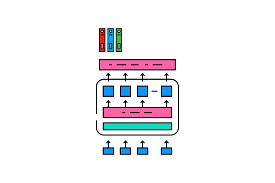
We use varied, reviewed Hungarian writing to teach the difference between human and machine authorship.
02The model studies connected patterns across a text, rather than looking for one giveaway word.
03Training happens in cycles: we measure, study failures, and improve the model deliberately.
04Only a version that performs consistently on unseen writing can reach real-world use.
Training data
We collect large volumes of expert-reviewed text. For each example we know whether it was written by a person or generated by AI, so the model can learn recurring patterns.
The corpus spans news, research, essays, professional material, and everyday writing. Sources are cleaned, faulty or duplicate items are removed, and no single topic, genre, or authorial style is allowed to dominate the dataset.
Before training begins, we split the data into three isolated parts. The model learns on the training set, development is checked on validation data, and the test set remains untouched until final evaluation. This prevents the same examples from appearing as both study material and exam questions.
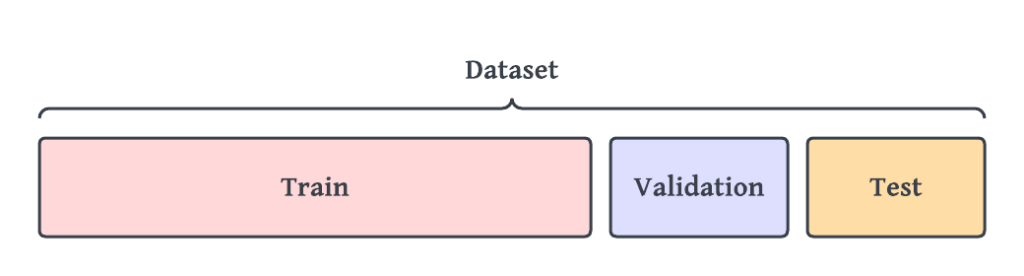
A model can only be as reliable as the examples and evaluation process behind it.
Every training example has a known origin. Uncertain or mixed-authorship texts are not treated as definite answers.
Different subjects, genres, lengths, and editing styles enter the dataset so the model cannot memorize one narrow pattern.
Final evaluation uses texts the model never saw during training. This reveals whether it can genuinely generalize.
The detection model
Preds is powered by an AI model whose task is classification rather than writing. From labeled human and AI-generated examples, it learns which relationships help distinguish the two origins.
It is not given a short list of forbidden words or rigid rules. Through large volumes of data, it gradually develops an internal representation in which sentence rhythm, connections, word choice, and consistency can be interpreted together.
This requires a large and diverse dataset. With too few examples, a model can easily memorize topics or superficial style. A broad, balanced corpus enables useful estimates on new texts it has never seen before.
The train of thought changes rhythm naturally, and the wording reflects personal choices.
Sentence rhythm changes naturally.
The author chooses specific, personal examples.
The wording is not fully predictable.
Digressions, self-corrections, and individual emphasis can appear.
The level of detail may vary between paragraphs.
Personal experience and decisions can shape the point of view.
Sentence structure and word choice create several related signals for the model.
Similar sentence structures may repeat more often.
Transitions can be unusually regular.
Word choice may remain consistently neutral for long passages.
Paragraph structure and length can appear notably even.
General statements may replace concrete lived experience.
The conclusion often restates the opening claim in a highly ordered form.
Training and refinement
We train the model, measure it on isolated data, collect difficult failures, and test it again. Only a version that demonstrates improvement under identical conditions can be released.
On the training set, the model updates its internal parameters and learns to connect text patterns with known labels.
During development, a separate dataset shows whether the model is genuinely improving or merely fitting the training examples more closely.
Short, edited, paraphrased, and uncertain texts expose weak points and become targeted new training examples.
The final candidate is measured on untouched test data. Only reproducible improvement reaches users.
Iterative development
A strong model is not the result of a single training run. In each cycle, we examine where it fails, add difficult examples to the dataset, and verify on independent tests that the improvement generalizes.
01 / Targeted search for difficult cases
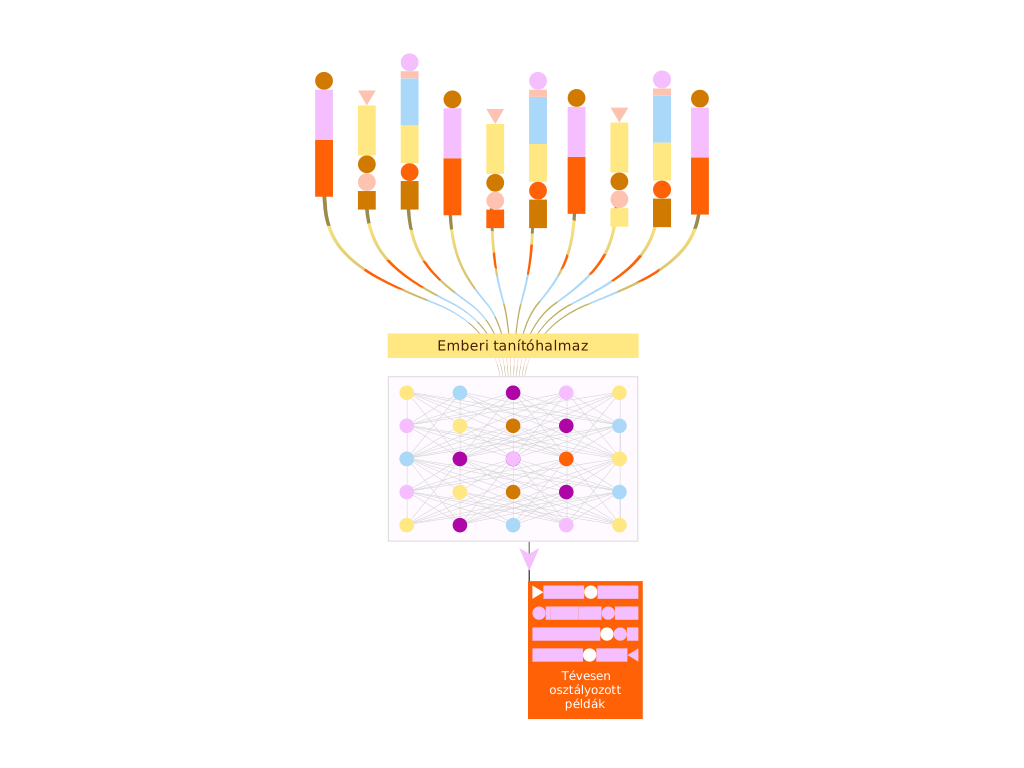
The initial model was already effective, but we wanted to increase accuracy further and reduce false positives—the incorrect labeling of human-written documents as AI-generated—as much as possible. To do this, we use a search process designed specifically for AI detection models.
The initial dataset alone did not provide enough information to turn a strong result into an exceptionally precise one. A model learns the basic patterns quickly, but it needs to see difficult edge cases to learn the finer distinctions.
We use the model to search large datasets for examples it judged incorrectly as human or AI-generated. We add these examples to the training data, retrain the model, and measure it again. After several cycles, the false-positive rate can approach zero while overall performance also improves on untouched test data.
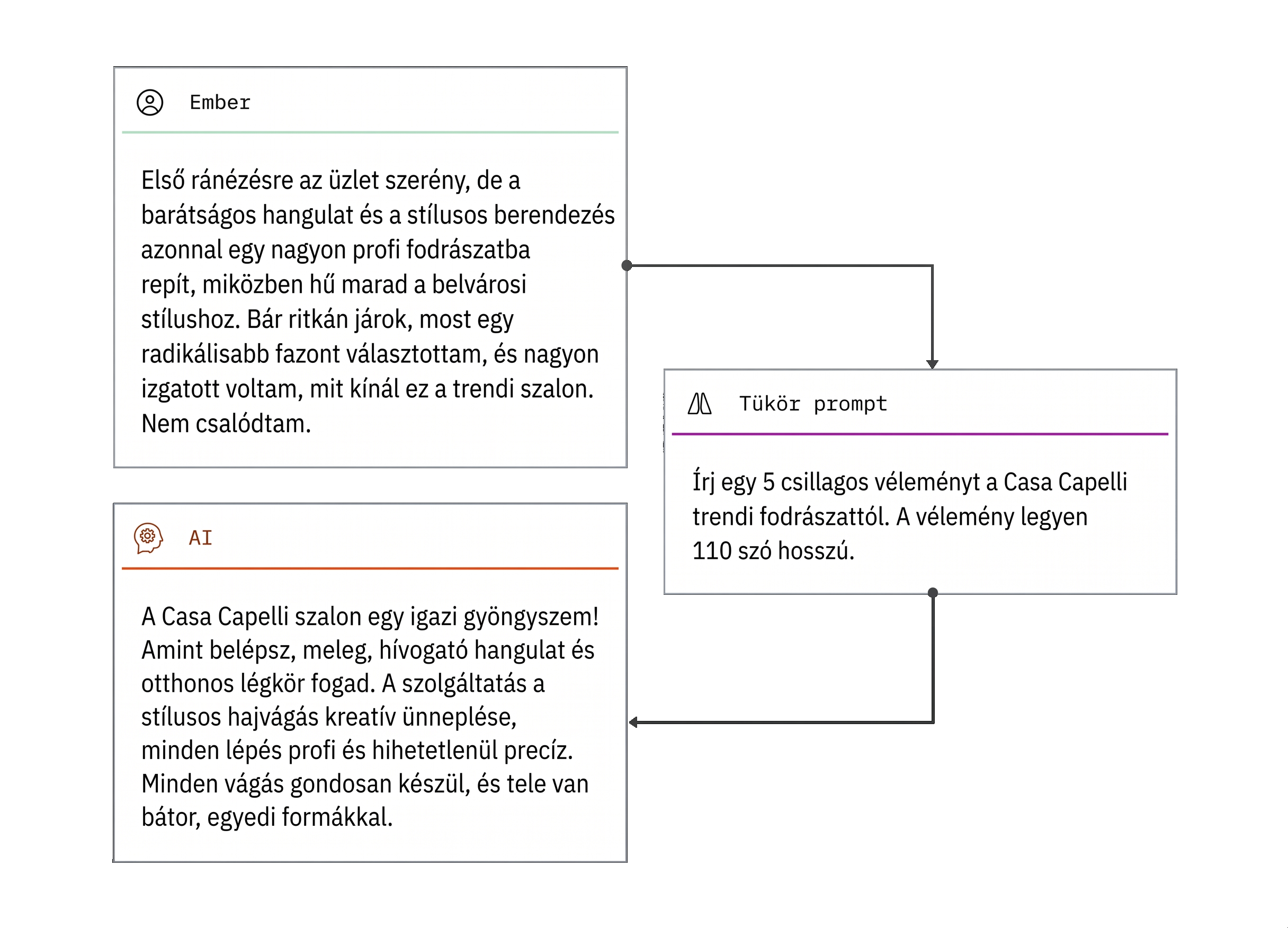
02 / Mirror prompts
We design the AI side of the dataset to resemble the human side as closely as possible in style, tone, and meaning. For each human example, we create an AI-generated example that answers the same task and follows the original document’s subject, genre, and length as closely as possible.
This keeps the model from learning the topic or document type. Instead, it learns the characteristics that are genuinely connected to linguistic origin. The authoring process is the meaningful difference between the two texts.
03 / Retraining and re-evaluation
We retrain the model with the updated training data and evaluate its performance at each step. We keep the same separated evaluation principles, so an improved score cannot simply mean that the model memorized the new examples.
This method reduces errors and increases accuracy beyond what is possible with ordinary training on an unchanged dataset. Only a model that improves consistently on new text can reach users.
Fig. 6. Each retraining cycle is evaluated, steadily reducing errors beyond what normal training achieves.
Ready to start testing?