




01
Sentence-level transparency
Alongside the overall result, suspicious and human-classified sections are highlighted separately passage by passage.
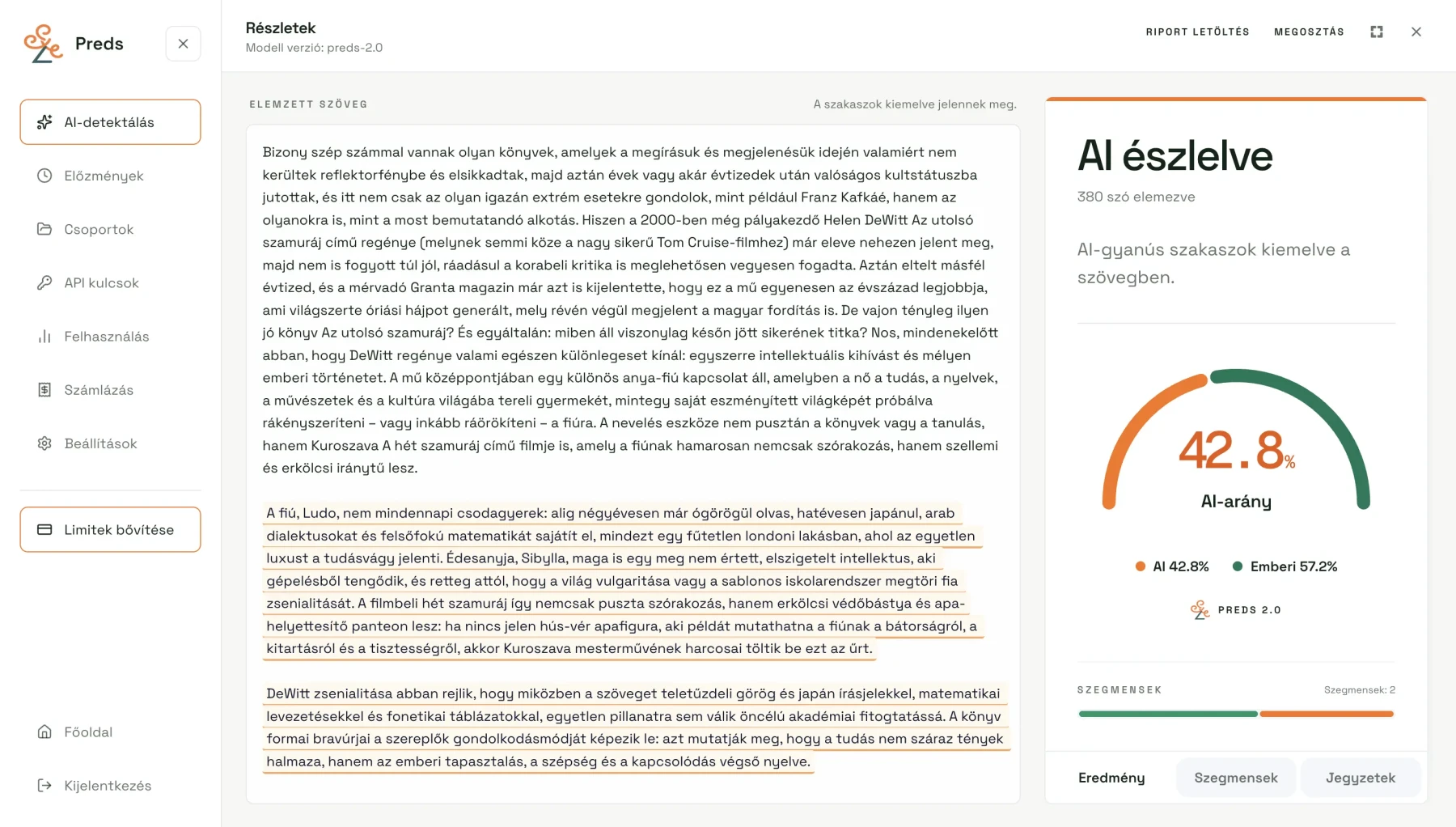
Check your Hungarian texts and see which parts were written by ChatGPT, Gemini, Claude, or another AI model.
We evaluated seven AI detectors on the same 1,000 Hungarian texts (500 human-written, 500 AI-generated). Preds 3 reached 99.6% accuracy and did not label any human text as AI-written. The developer of Preds built the dataset and ran the measurement; the data is public.
Compare Hungarian AI detectorsBenchmark / Hungarian / 1,000 documents
| Rank | Detector | Accuracy | False positive |
|---|---|---|---|
| 01 | Preds 3 | 99.6% | 0.0% |
| 02 | GPTZero | 90.1% | 0.2% |
| 03 | Originality.ai | 82.0% | 32.6% |
| 04 | Plag.hu | 76.5% | 0.4% |
| 05 | isgen.ai | 65.5% | 1.4% |
| 06 | ZeroGPT | 64.7% | 34.8% |
| 07 | Smodin | 62.9% | 0.4% |
False-positive rate: human text incorrectly flagged as AI.
The benchmark was conducted in late September 2026.
Choose from the examples, paste your own Hungarian text, or import a document. The result opens in the Preds dashboard.
How does the AI detector work?Preds clearly shows which parts are suspicious in a text.
Alongside the overall result, suspicious and human-classified sections are highlighted separately passage by passage.
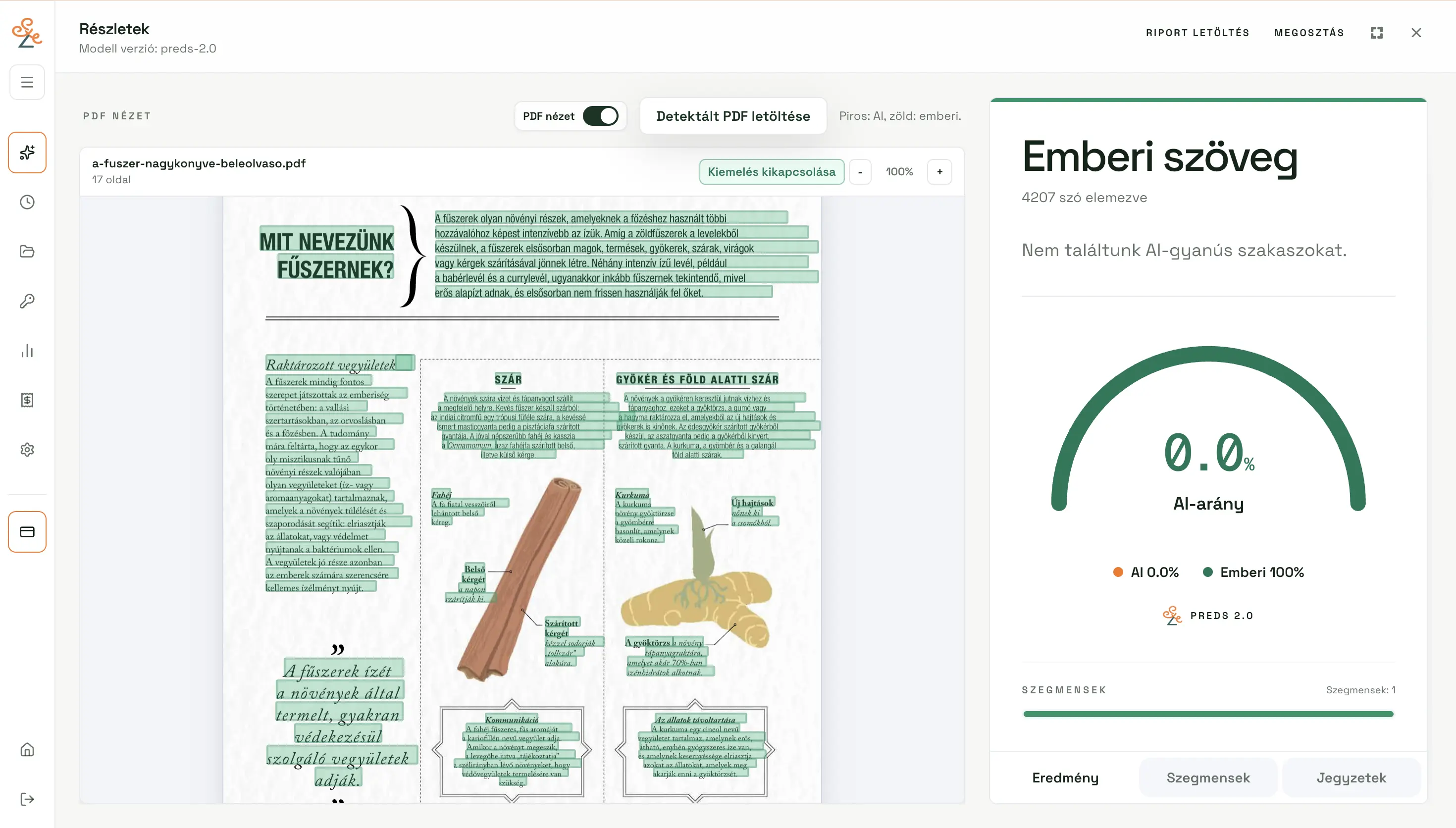
Upload a PDF document and view detection results directly in the original document.
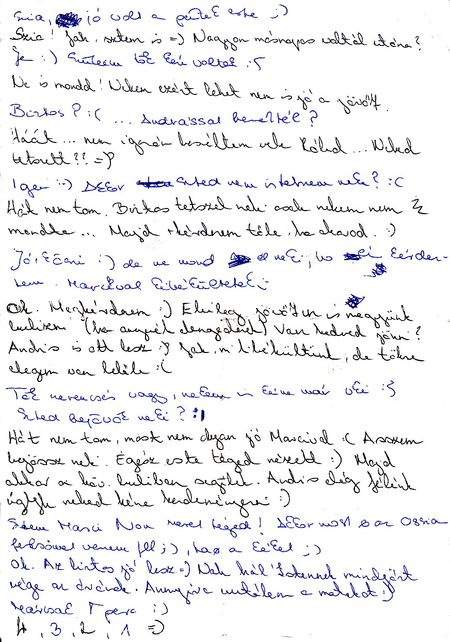
We digitize text from photographed assignments and notes, then detect suspicious parts in the same way.
Automate large volumes of content verification with the Preds API. An easily integrated solution for any system.
{
  "language": "hu",
  "prediction": "human",
  "confidence": 0.978
}Hungarian AI text detection for the way you work. Find your use case and see where to start.
Review essays and assignments sentence by sentence, and use the highlights to guide your feedback.
Explore this use caseCheck your thesis or coursework for signs of AI writing before you submit it.
Explore this use caseSupport academic review with detailed checks of Hungarian theses and research papers.
Explore this use caseReview articles and manuscripts for AI-generated passages before publication.
Explore this use caseCheck blog posts, web pages and product copy for signs of AI writing before they go live.
Explore this use caseReview longer cover letters and application answers to guide your follow-up questions.
Explore this use caseTry it on your own text.
Paste a Hungarian text into the demo and explore the passages Preds highlights.
The result is an estimate, not proof. Review the complete text and its context before making a decision.
On the public test dataset of 1,000 texts, Preds 3 reached 99.6% accuracy and did not label any human text as AI-written. No AI detector is infallible, however: short, heavily edited or translated texts carry a higher error rate, so the result is best used to support a decision, not as proof.
How it worksWe compared Preds with other detectors on the same 500 human-written and 500 AI-generated Hungarian documents. Preds 3 achieved 99.6% accuracy on this test.
Uploads are protected in transit. Source files are held temporarily for text extraction and deleted afterward; extracted text is encrypted while available for review before submission.
The data on which the Preds model was trained was crafted to include as many domains as possible: news, legal and administrative texts, scientific and educational materials, community content, creative writing, as well as technical and financial texts.
False positive means flagging human text as AI-generated. This is a critical mistake, which is why our model was designed to keep this error minimal. On the public test dataset it labeled none of the 500 human texts as AI-written, and on our internal test dataset the false-positive rate is 0.42%.
Fresh articles about research, operations, and advice in the world of AI detection.
All articles 01
Csábító azt gondolni, hogy mivel az LLM-eket az emberi szöveg modellezésére tanítják, a kimenetük megkülönböztethetetlenné válik az emberi írástól. A valóságban azonban az LLM-ek nem csupán megközelítik az emberi szöveget: utótanítással (post-training) olyan segítőkész asszisztensekké alakítják őket, amelyek követik az utasításokat, ez pedig egy szűk tartományra korlátozza az írásukat, amely felismerhető marad.
Read article 02
A Preds 3 jelentős előrelépést képvisel a korábbi 2.0-s verzióhoz képest. A mérési eredmények kimagaslóak lettek: tovább csökkent a téves felismerések (fals pozitívok) aránya, miközben a detektálás pontossága érezhetően nőtt.
Read article 03
Sok AI-detektor állítja magáról, hogy ők a legjobbak a szintetikus szövegek felismerésében. Ebben a témában szeretnék egy szemfelnyitó mérést és cikket bemutatni, amely megmutatja a valóságot.
Read articleKey questions about accuracy, data handling, and usage.
An AI detector, also called an AI text checker, estimates whether a text contains patterns associated with machine writing. Preds is built for Hungarian texts, including essays, theses, news articles and other longer documents. It provides an overall estimate and highlights suspicious sentences. The result is an estimate and does not establish authorship on its own.
In a personal account, uploaded texts, checks, and history are private by default: other Preds users cannot search or browse them. A result becomes accessible to others only if you explicitly create a public sharing link for it. In an organization account, access depends on the organization's permission settings.
Preds is built specifically on high-quality Hungarian-language data, taking into account the unique characteristics of Hungarian texts. Alongside high accuracy, we emphasize a low false-positive rate and transparent, sentence-level results.
The Preds model is itself an AI model that learned to distinguish human writing from machine generation on a massive volume of Hungarian texts. It provides a probabilistic result with confidence scores for pasted text and highlights suspicious passages sentence by sentence. The result is a decision-support signal, not definitive proof of authorship.
Preds is free to use: every user receives 2 free credits per day. The daily allowance resets to 2 credits each day and unused free credits do not roll over. No credit card is required to sign up. For larger volumes, subscriptions or credit packages are available.
Yes, no AI detector is infallible. On the public HuDetect-1k test dataset of 1,000 texts, Preds 3 reached 99.6% accuracy and did not label any human text as AI-written; on our internal test dataset the false-positive rate is 0.42%. The margin of error is higher for short, heavily edited, or translated texts, so results should be weighed alongside additional context.
Preds recognizes text written by ChatGPT, Claude, Google Gemini, DeepSeek, Meta AI, Grok, Llama, Mistral, Perplexity, and Deep Research artificial intelligence. In addition, it detects "humanizer" tools such as Grammarly and QuillBot.
No. A plagiarism checker looks for matches with other sources. An AI detector looks for writing patterns associated with AI generation. Preds AI detection therefore does not replace plagiarism checking: an original text can receive a false AI signal, and copied text can appear human-written.
Yes, detection from files is supported. We support TXT, PDF, DOCX, Markdown, and image formats. Detection can also be run on handwritten texts, which is available in the Essential and Pro subscriptions.
No credit card needed, no complex setup. Paste your text and receive fast, transparent results.